

service design
Why should this exist?
Eric Hazan of McKinsey speaks about the importance of omnichannel retail, “We are entering the world of “phygital”—physical and digital at the same time, where there is not a physical world or digital world in retail, but rather a completely connected one.”
In the context of a personalised experience, he says, “if you don’t invest in analytics, if you don’t invest in personalisation, the barriers to entry that others will build will be too high.”
Changing times have necessitated the adoption of a renewed strategy to market.
Sharon Gee of BigCommerce speaks to the acceleration of e-commerce in that it “has forced everyone to operate at a much higher level of digital maturity.”
She further appends “To succeed today, retailers need to put a stake in the ground and define a unified channel strategy from a digital and physical perspective” suggesting the substance in cross-channel presence.
These statements are clear indicators of the innovation needed to add value and convenience to retail experiences.
These statements are clear indicators of the innovation needed to add value and convenience to retail experiences.

Exising User Journey
Mapping the current user journey to identify deterrents and pain-points.
The project focuses on re-utilising the retail app on the user’s phones to curate a more personal and accessible version of the present, less-than-seamless in-store shopping process.

Altered User Journey
When a person enters the store, they receive a prompt such as a push notification to launch the app for an enhanced experience. The same app used for online purchases now defaults to an in-store environment, providing location-specific information relevant to the user, such as a continually changing store layout.
From here, the physical store can be explored with assistance from the online extension.
This is achieved by introducing features to easily find what the shopper is looking for, by making suggestions informed by the user’s shopping preferences, and by removing unnecessary wait times with virtual queues, allowing more time to browse merchandise.

Information Architecture
From an overarching task analysis, it can be concluded that shoppers may know what they want, may wish to discover new items in their style, may be in a hurry or may be looking for something for someone else.
The information organisation must be mindfully simple and as detangled as possible so as not to frustrate the user while they navigate two varied environments simultaneously.

Conceptual Prototype
These conceptual representative screens illustrate how the app extension would work to perform the functions of easy wayfinding, shopping assistance and virtual queueing.
A possible solution for a phone to physically identify the shopping aisles might simply be to use the Bluetooth functionality. A request to allow connecting to the store Bluetooth at launch or download could assist with this.
Other technological solutions could be ZigBee or SoftAP, a WiFi technology that creates an in-built WiFi radio in each communicating device.
The logistics and feasibility of these options are beyond the scope of this exploration.
01
The landing screen shows the store layout.
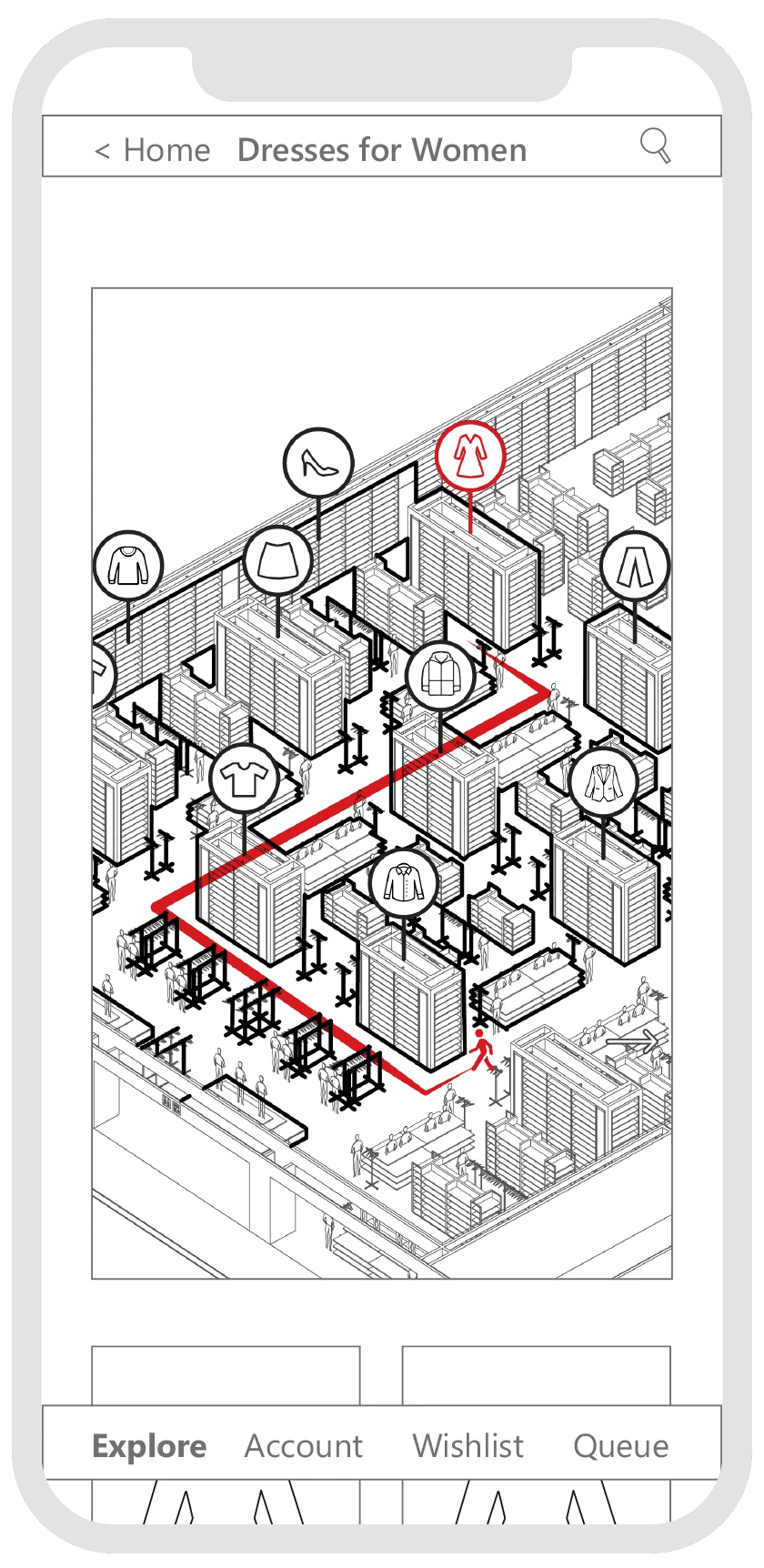
Tapping on a category directs you to the aisle, while scrolling down on this screen previews what you might find there.


02
The Explore tab allows the user to see what is new in store or look for items suggested from their online shopping patterns.
Once an item is selected from the product catalogue, the user is shown a path to the aisle it may be found in.
Further, upon reaching a 10m radius of the product, the navigation adapts to make finding it even easier.


03
The Queue tab clearly shows options to join a virtual waiting line for Fitting Rooms or Billing.
Each allows the user to see an approximate time to their turn, forfeit their position by one or leave the queue at any time.


04
The Wishlist tab displays the user’s prior online selections.
On tapping on an item, the app displays whether it’s available in the store or not.
In case it is in stock, the user is given directions to the aisle where the product can be found.
